
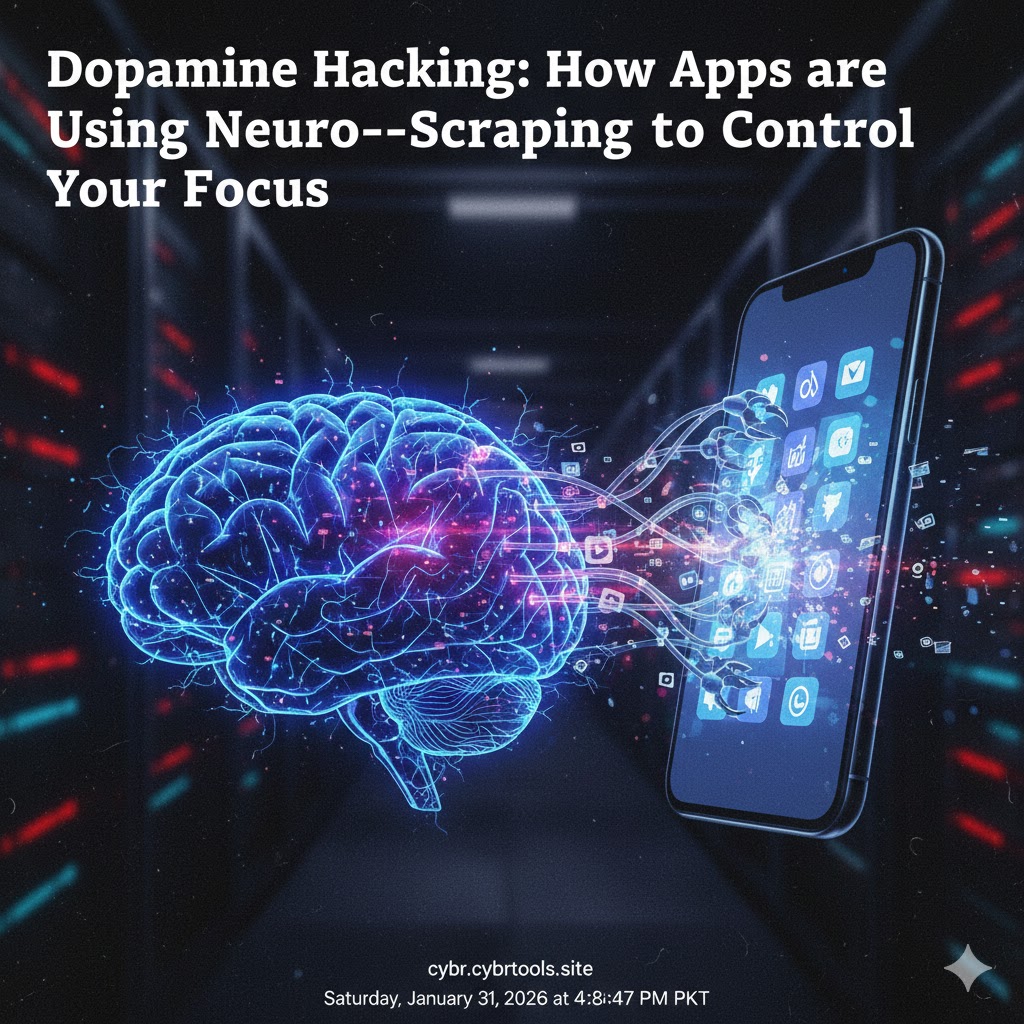
The Invisible Hook
Have you ever picked up your phone just to check a single notification, only to “wake up” 45 minutes later, realizing you’ve been mindlessly scrolling through a feed of random videos? You aren’t alone. We have all been there. In 2026, the most dangerous form of hacking isn’t targeting your passwords or your bank accounts it’s targeting your brain.
This phenomenon is known as “Dopamine Hacking.” Major tech corporations have moved beyond simple data collection; they now employ “Neuro-Scraping” algorithms designed to map your chemical rewards system. Their goal is simple: to keep your eyes glued to the screen at any cost. In this deep dive, we will explore how this psychological warfare works and how you can reclaim your digital sovereignty.
My Personal Struggle: The Midnight Scroll Loop

For a long time, my mornings followed a destructive pattern. I would wake up, reach for my phone before even getting out of bed, and spend the first hour of my day trapped in a “Dopamine Loop.” I convinced myself I was just “checking the news” or “staying informed,” but the reality was much darker.
I began to notice that my ability to focus on complex tasks was evaporating. My brain was constantly craving a “hit”—a like, a comment, or a catchy headline every five minutes. I felt like my attention wasn’t mine anymore; it was being rented out to the highest bidder by the apps on my home screen. This personal crisis led me to research how “Neuro-Scraping” actually functions. This article is the result of that journey toward recovery and digital clarity.
1. What is Neuro-Scraping?

Neuro-scraping is no longer the stuff of science fiction. When you engage with an app, the platform isn’t just looking at what you “Like” or “Share.” They are scraping the subconscious data points that you aren’t even aware of.
- Dwell Time Analysis: The AI tracks exactly how many milliseconds you pause on a specific image compared to another.
- Scroll Velocity: It monitors when your scrolling speed slows down, indicating a spike in interest or an emotional trigger.
- Biometric Feedback: In 2026, many apps use front-facing camera data (with subtle permissions) to track eye movement and pupil dilation to gauge your level of excitement.
This massive amount of data is used to build a “Neuro-Profile.” Once this profile is complete, the algorithm stops guessing. It knows exactly what type of content will trigger a release of Dopamine the chemical associated with pleasure and reward—in your brain. It is a digital drug with no physical form, but its addictive power is unparalleled.
2. The Slot Machine Effect in Your Pocket

The design of modern social media is intentionally modeled after Las Vegas slot machines. Have you ever wondered why the “Pull to Refresh” feature exists? It mimics the mechanical lever of a slot machine. The split-second delay before the new content appears creates “Variable Rewards” the psychological uncertainty that keeps you coming back for more because you might see something amazing next.
At cybr.cybrtools.site, we often discuss software firewalls and encryption to protect your data. However, Dopamine Hacking requires a “Mental Firewall.” Without it, even the most secure device becomes a portal for psychological manipulation.
3. Why 2026 is the Peak of Digital Addiction

The AI of 2026 is far more advanced than the simple recommendation engines of the past. Today’s algorithms can predict your mood swings before you even feel them. If the data suggests you are feeling lonely or nostalgic, the algorithm will pivot to show you content that exploits those specific vulnerabilities to keep you connected.
Apps are no longer passive platforms; they are Behavioral Modification Engines. They scrape our human weaknesses and weaponize them against us to maximize ad revenue. In this economy, your focus is the product, and your time is the profit.
4. The True Cost of Lost Focus

The damage of Dopamine Hacking goes far beyond just “wasted time.” The long-term effects on the human psyche are profound:
- The Death of Deep Work: Our brains are being rewired to prefer short-form, shallow content. This makes it nearly impossible to concentrate on difficult, meaningful work for more than ten minutes at a time.
- Anxiety and Comparison: By constantly scraping the “perfect” lives of others, our brains experience a dopamine crash when our real, everyday lives feel boring by comparison.
- Privacy Erosion: When we are in a state of “infinite scroll,” our critical thinking shuts down. We become more likely to click on dangerous links or grant intrusive permissions just to keep the content flowing.
We offer various utilities in our Web Tools Hub to clean up your browsing experience, but these tools are useless if the user is too addicted to look away from the screen.
5. How to Hack Back: Reclaiming Your Brain
After realizing how deep my own addiction went, I implemented several “Counter-Hacks” to regain control. These aren’t just tips; they are survival strategies for the digital age:
- Switch to Greyscale Mode: Most of the dopamine trigger comes from the vibrant, saturated colors of app icons. By turning your phone screen black and white, you make the device “boring” to your brain, drastically reducing the urge to check it.
- The 20-Minute No-Phone Rule: Do not touch your phone for the first 20 minutes after waking up. Allow your brain to generate its own natural dopamine through sunlight or movement rather than a digital hit.
- Audit Your Notifications: If a notification doesn’t involve a real person trying to reach you, it shouldn’t be allowed to buzz in your pocket. Turn off all “recommendation” and “engagement” alerts.
- Embrace Boredom: We have lost the ability to sit in silence. Reclaiming your focus starts with allowing yourself to be bored. This is when the best creative ideas are born.
6. A Call for Digital Ethics
It is time we hold tech giants accountable for the mental health crisis they have engineered. While we fight for laws against “Web Scraping” of our personal data, we remain silent about the “Neuro-Scraping” of our attention. We need a new era of digital ethics where tools are designed to serve humans, not to enslave their focus.
At cybr.cybrtools.site, our mission is to empower you with the knowledge to stay safe in every sense of the word—whether that’s protecting your files from a virus or protecting your peace of mind from an algorithm.
Conclusion: You are Not a Statistic
Your mind is the most valuable resource on this planet. Do not let it be harvested by a line of code designed to sell sneakers or political ads. Every time you choose to put the phone down, you are winning a small battle against a multi-billion dollar machine.
Be conscious. Be secure. And most importantly, stay human in this digital age.





Leave a Reply