
My journey into the world of high-stakes cybersecurity began with a single, costly mistake while launching my first “Digital Utility” tool. I remember the moment clearly: I decided to “temporarily” hardcode an API key into my script to save fifteen minutes of configuration time. I told myself, “Who’s going to notice? I’ll remove it before the final push.”
But in the digital landscape of 2026, the internet never sleeps. Within exactly 42 seconds of my code hitting a public repository, an automated bot detected the key. By the time I woke up the next morning, a hacker had used my credentials to spin up high-compute clusters, leaving me with a cloud bill exceeding $14,000. That day, I learned a brutal lesson: Convenience is the greatest enemy of Security. Today, on cybr.cybrtools.site, my mission is to ensure you don’t repeat my history. In this guide, I’ve distilled years of recovery experience into a roadmap that protects your “Web Tools” and “Security Tools” from the $1.2 trillion API disaster currently looming over the industry.
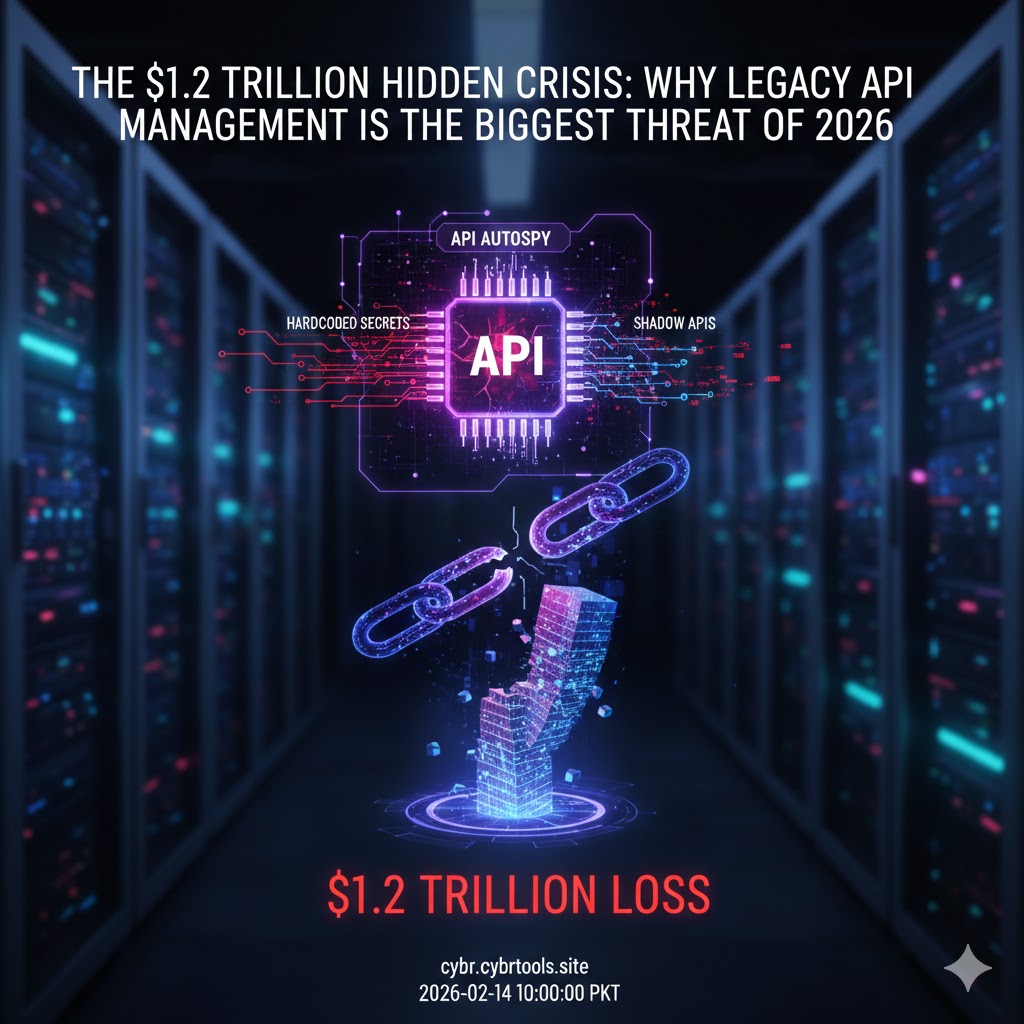
In the rapidly evolving digital landscape of 2026, the backbone of every modern application isn’t just code—it’s the API (Application Programming Interface). However, as we integrate more “Digital Utilities” into our workflows, we are inadvertently creating a massive, invisible attack surface. Recent data suggests that API-related breaches could cost global businesses over $1.2 trillion this year alone.
If you are a developer, a sysadmin, or a tech enthusiast using cybrtools.site, understanding the anatomy of an API disaster is no longer optional it’s a survival skill.
1. The Anatomy of an API Autopsy: Beyond Hardcoded Secrets

“The Silent Leak: Why your most secure servers are crying for help.”
Most cybersecurity beginners think that “hacking” involves complex social engineering or brute-force attacks. In reality, the most devastating disasters often start with a simple oversight: Hardcoded Secrets. When a developer leaves an API key or a database credential inside a public GitHub repository, it’s like leaving the master key to a bank vault under the doormat.
But in 2026, the threat has evolved. We are seeing “Shadow APIs”—endpoints that are no longer in use but still active on the server. These legacy portals are the primary entry points for modern ransomware.
- Actionable Tip: Use a Secret Management Tool to automate your credential rotation. Never store raw keys in your
.envfiles without encryption.
2. Digital Utilities vs. Cyber News: The Innovation Paradox

“The Speed Trap: Why fast deployment is the enemy of deep security.”
The demand for “Digital Utilities” (calculators, converters, API testers) has skyrocketed. Developers are under immense pressure to ship features daily. This “Sprint Culture” often leads to:
- Broken Object Level Authorization (BOLA): Where a user can access another user’s data by simply changing an ID in the URL.
- Lack of Rate Limiting: Allowing bots to spam your utility tools, leading to massive server bills and potential DDoS scenarios.
According to latest Cyber News, over 60% of utility-based web apps are vulnerable to basic injection attacks because they trust user input too much.
3. The $1.2 Million Disaster: A Real-World Scenario

Let’s look at a hypothetical (but highly realistic) scenario for a mid-sized SaaS company.
- The Error: A junior dev pushes a “Web Tool” that helps users convert JSON to CSV.
- The Leak: The tool’s backend uses a premium AWS API, and the key is left in the client-side JavaScript.
- The Result: Within 4 hours, botnets discover the key. They use it to spin up thousands of high-compute instances for crypto-mining.
- The Bill: By Monday morning, the company owes AWS $1.2 million.
This isn’t just a security failure; it’s a business-ending event. You can check your own vulnerability status using our Web Tools section to audit your public endpoints.
4. Security Tools for 2026: The Zero-Trust Mandate

“The Recovery Formula: Moving from reactive patches to proactive defense.”
To combat these threats, the industry is moving toward a Zero-Trust Architecture. This means:
- Identity-First Security: Don’t trust the IP; trust the authenticated token.
- API Gateways: Using a central hub to monitor every request coming into your “Web Tools.”
- Automated Scanning: Integrating tools that scan your code for secrets before you hit “git commit.”
For anyone managing a site like cybrtools.site, implementing a robust Security Tool suite is the first step toward long-term stability.
5. Conclusion: Building a Safer Digital Future
The transition from a simple web developer to a security-conscious engineer is the most important career move you can make in 2026. Whether you are building “Digital Utilities” or reporting on “Cyber News,” the goal remains the same: Protect the Data.
Stop treating security as a “final step.” Make it the foundation of every line of code you write.





Leave a Reply