
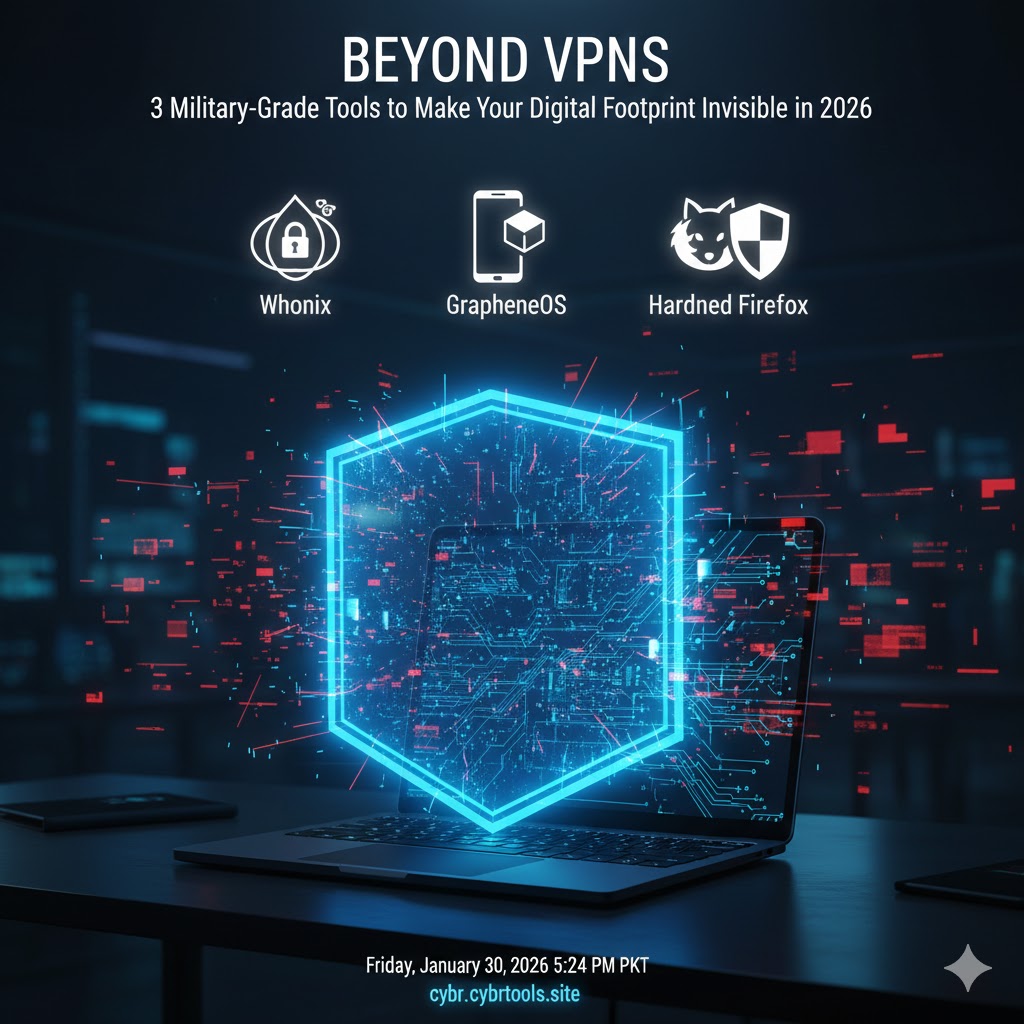
The Illusion of the “Private” Toggle
Most people believe that clicking “Go Incognito” or toggling on a $5-a-month VPN makes them a digital ghost. I hate to break it to you, but in 2026, that’s like wearing a plastic mask to a high-tech masquerade ball everyone still knows exactly who you are.
Between browser fingerprinting, cross-site tracking, and AI-driven data harvesting, your digital footprint is more like a digital “crater.” If you are serious about privacy on cybr.cybrtools.site, you need to look past the marketing fluff of mainstream VPNs and start using tools that were once reserved for whistleblowers and security researchers.
My Personal Realization: The Day I Found My “Invisible” Self
I remember a night last year when I was testing a new “privacy-focused” browser. I had my VPN set to Switzerland, my tracking blockers on “Aggressive,” and I felt invincible. Then, I visited a simple fingerprinting test site. Within seconds, the site identified my exact screen resolution, my battery level, the fonts installed on my PC, and my hardware specs. Despite the VPN, I was 1 of 1 unique and trackable.
That was my “wake-up” moment. I realized that a VPN only changes your IP address; it doesn’t change your identity. This led me down a rabbit hole of military-grade tools. I spent weeks breaking my own system to see what actually works. The three tools I’m about to share are the ones that actually made me disappear.
1. Whonix: The Ultimate Privacy Fortress

If a VPN is a curtain, Whonix is a concrete bunker underground. Unlike a standard OS, Whonix consists of two parts: a Gateway and a Workstation.
- How it works: All your traffic is forced through the Tor network at the system level. Even if an application is compromised by a hacker, it cannot find your real IP address because the “Workstation” part of the OS has no idea what your real IP is.
- My Experience: Setting up Whonix was a learning curve. It’s not as “click-and-play” as a Mac or Windows. But the first time I ran a leak test and saw that my system was completely leak-proof even against DNS hijacks I knew I could never go back to “normal” browsing for sensitive tasks.
For more on how to secure your OS environment, check out our Security Tools Hub.
2. GrapheneOS: The “De-Googled” Smartphone

We carry tracking devices in our pockets 24/7. Most people don’t realize that Android and iOS are constantly sending “telemetry” data back to big tech.
- The Solution: GrapheneOS. It is a hardened, privacy-focused mobile OS that strips away all Google Play Services. It uses “Sandboxed Google Play,” meaning if you must use a Google app, it lives in a tiny box where it can’t spy on the rest of your phone.
- The Transformation: When I switched my primary phone to GrapheneOS, my battery life doubled. Why? Because there weren’t 50 different tracking scripts running in the background trying to report my location to an ad server. It’s the closest you can get to a “Burner Phone” while still having a modern smartphone experience.
3. ProxyChains & Hardened Firefox (The Browser Fingerprint Killer)

This is where we get into the “Web Tools” territory. Fingerprinting is the most dangerous threat in 2026. Websites identify you by the way your browser “looks.”
- The Strategy: I started using ProxyChains on Linux to layer multiple proxies, but for the average user, the “Hardened Firefox” (using
user.jsfiles like Arkenfox) is the real hero. It disables the APIs that websites use to “measure” your device. - The Result: Instead of being a unique user, my browser now looks exactly like thousands of other privacy-conscious users. I became “one of the crowd,” which is the true definition of digital invisibility.
The Math of Privacy: Why You Can’t Afford to Wait
At cybr.cybrtools.site, we often talk about the cost of hacks. But what about the cost of data? In 2026, a “Clean Digital Identity” is worth thousands of dollars on the dark web. By using these tools, you aren’t just being “paranoid”—you are protecting your financial future.
If your voice can be cloned in 10 seconds (as we discussed in our Cyber News Section), imagine what a hacker can do with your entire browser history and location data. Privacy is no longer a luxury; it is your digital armor.
Final Verdict: Start Small, But Start Now
You don’t have to switch to Whonix today. Start by hardening your browser. Then, look into a privacy-first OS. The goal isn’t to be perfect; the goal is to be a “hard target.” Hackers and data brokers look for easy prey. When you use military-grade tools, you become too expensive and too difficult to track.





Leave a Reply