
The Human Realization: When Your Ears Betray You
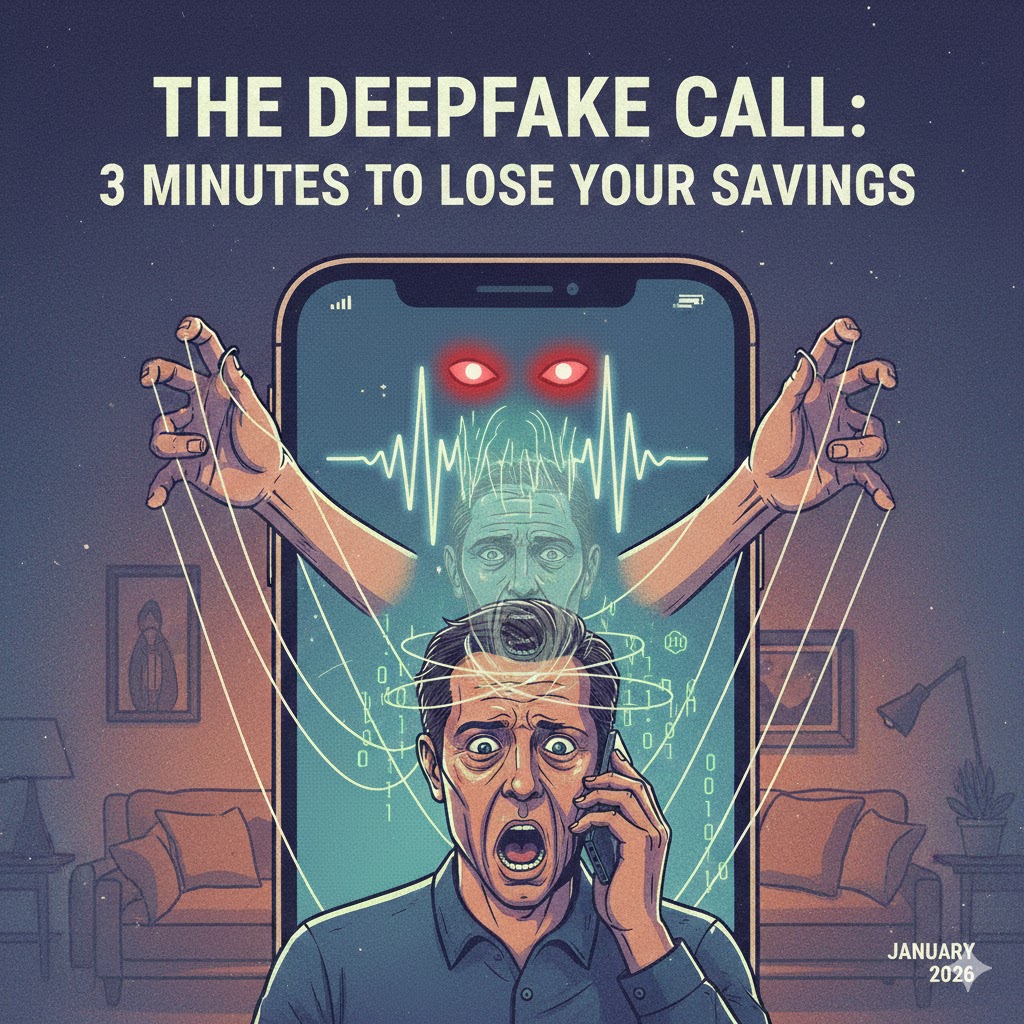
I never thought a simple phone call could become my worst nightmare. A few days ago, during a quiet afternoon, my phone rang. The caller ID showed my younger brother’s name. I picked up, and what I heard sent a shiver down my spine. It was his voice—the exact same pitch, the familiar stutter when he’s nervous, and that specific way he says my name. He sounded terrified. He told me he had been in a horrific accident, the police were threatening to arrest him, and he needed an immediate bank transfer to settle the matter before his phone was confiscated.
In that moment, panic took over. I was already opening my banking app, my hands trembling. But then, a tiny flicker of logic kicked in. I remembered he was supposed to be on a flight to London at that exact hour. I hung up, my heart racing, and checked his flight status. He was safely in the air, disconnected from the world. That call wasn’t from my brother; it was an AI-generated Deepfake. Those three minutes were the most terrifying moments of my life. It was the day I realized that in 2026, we can no longer trust our eyes, and more dangerously, we can no longer trust our ears. The “System” isn’t just tracking us anymore; it is stealing the voices of those we love to hollow out our bank accounts.
The Science of Voice Cloning: How the Illusion is Created
Deepfake voice technology, scientifically known as “Voice Cloning” or “Speech Synthesis,” has reached a level of terrifying perfection. Only a few years ago, you needed hours of high-quality studio recordings to mimic a person’s voice. Today, thanks to advanced neural networks, a scammer needs as little as 3 seconds of audio.
Think about where your voice exists online. It’s in that Instagram reel you posted, the LinkedIn video update, or even a snippet from a public speech or a recorded customer service call. Scammers use “Web Scrapers” to find these audio clips. Once they have a sample, the AI analyzes the “Prosody” of your speech—the rhythm, the emotional inflection, and the unique breath patterns that make you sound like you. By the time the scammer types a script into their software, the AI breathes life into those words using your identity. It is a digital mask that is impossible to see through without a skeptical mind.
Why Is This Happening Now? (The 2026 Connectivity Trap)

We previously discussed in our article, Shadow Bans & Silent Tracking: Your Phone’s Dirty Secret, how our devices are constantly harvesting metadata. This is where the two worlds collide. Scammers don’t just call you randomly; they use the metadata leaked from your apps to know exactly who your family members are, where they travel, and when they are most likely to be unavailable.
In 2026, data brokers sell “vulnerability profiles.” They know if you have an elderly parent living alone or a sibling traveling abroad. This allows the scammer to time their “Deepfake Call” perfectly. When you combine the precision of tracking with the emotional weight of a loved one’s voice, the success rate of these scams skyrockets. It is a sophisticated, multi-layered psychological attack disguised as a family emergency.
The Psychology of the 3-Minute Trap: Fear Over Logic

Scammers rely on a very specific window of time: the 3-minute mark. Within this window, they aim to bypass your logical brain and trigger your “Amygdala”—the part of the brain responsible for the fight-or-flight response.
- The Emotional Hook: The call starts with a high-stress greeting like “Mom, please help me!” This immediately shuts down critical thinking.
- The Artificial Crisis: They create a scenario where every second counts—a medical emergency, a legal threat, or a kidnapping.
- The Urgent Solution: They provide a quick way out via crypto, wire transfer, or digital payment apps.
By keeping you on the phone and keeping the pressure high, they ensure you don’t have time to pause, breathe, or call the person back on a separate line. They are not just stealing your money; they are weaponizing your empathy and love against you.
How to Ghost the Voice Scammers: The “Safe-Word” Strategy
As technology evolves, our traditional security measures like passwords and 2FA are becoming insufficient against social engineering. We need “Human Solutions” for “AI Problems.” Here is how you can protect your inner circle:
- The Family Safe-Word: This is the most effective defense. Establish a secret word or phrase with your family that is never shared online or via text. If you receive an emergency call, ask for the “Code.” An AI cannot guess a word that doesn’t exist in its training data.
- The Multi-Channel Verification: Never trust the incoming line. If your “child” calls from a new number saying they lost their phone, hang up and call their original number. Use a different app (like WhatsApp or Telegram) to send a message to a mutual friend or spouse to verify the person’s location.
- Audio Privacy: Be mindful of the audio you post publicly. If you are an influencer or a professional who speaks publicly, understand that your voice is now a “Biometric Key.” Treat it with the same caution you would treat your fingerprint or your home address.
- Listen for the “Glitch”: While AI is good, it isn’t perfect. Listen for unnatural silence between words, a slight “metallic” hum in the background, or an inability of the caller to answer a specific, personal question that only the real person would know.
The Connection to Digital Kidnapping & Identity Theft
This is the evolution of what we call Digital Kidnapping. It started with people stealing photos of children to create fake lives; now, they are stealing the very essence of your persona. Your digital identity is no longer just a profile picture it is your voice, your gait, your metadata, and your relationships.
In 2026, the cost of being “connected” is constant surveillance. Scammers are the vultures circling the data being leaked by Big Tech. When you realize that the “System” is rigged to prioritize data collection over user safety, you begin to understand why these scams are so prevalent.
Final Thoughts: The Future of Trust in an AI World
We are entering an era where “Trust” is the most expensive commodity on earth. Technology has provided us with incredible tools for connection, but it has also stripped away our fundamental sense of security. The next time your phone rings and a loved one is screaming for help, I want you to remember my story.
Pause for five seconds. Take a breath. Check the facts. The system is designed to make you act fast and think later. To survive in 2026, you must do the opposite: Think fast, and act slow. Your savings, and your peace of mind, depend on it.




Leave a Reply