
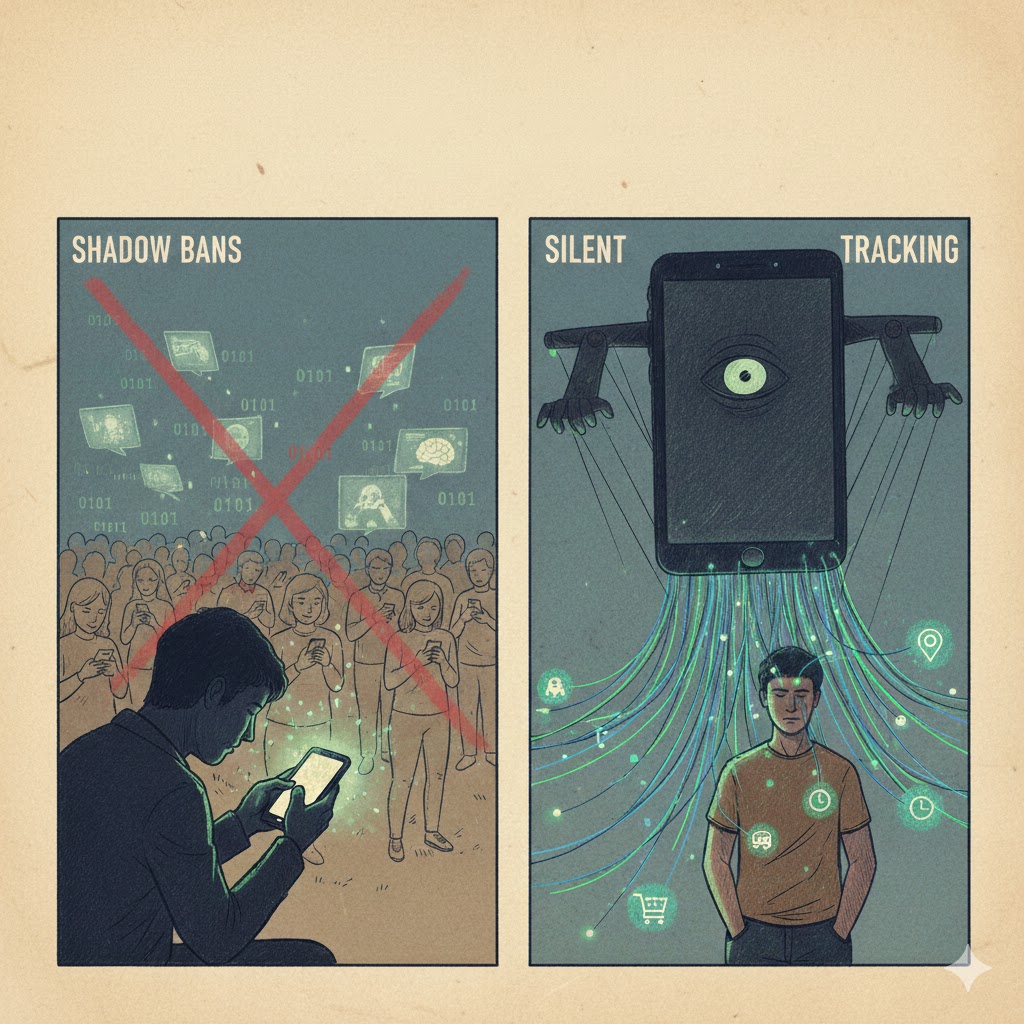
We have all been there. You are talking to a friend about wanting a new pair of hiking boots. You haven’t searched for them. You haven’t typed the name into a single app. But ten minutes later, you open Instagram, and there it is: a high-definition ad for the exact brand of boots you just mentioned.
The immediate reaction is a chill down the spine. You look at your phone and wonder, “Is it listening to me?” The tech giants claim they don’t “listen” through the microphone for advertising purposes. But in 2026, the reality is much more sophisticated, and much more invasive than a simple hidden microphone.
The Myth of the Microphone vs. The Reality of Metadata

While we worry about the “Mic,” the real theft is happening through your Metadata. Metadata is the digital breadcrumb trail you leave behind every second. It’s not just what you say; it’s where you are, who you are with, how long you stare at a screen, and even the angle at which you hold your phone.
Algorithms have become so predictive that they don’t need to hear your voice to “know” your thoughts. They analyze:
- Proximity Tracking: If your phone and your friend’s phone are in the same GPS coordinate and they recently searched for “Hiking Boots,” the AI assumes you are interested too.
- Behavioral Biometrics: The way you scroll and the millisecond pauses you make on certain images tell the AI more about your desires than a 5-minute conversation ever could.
This is the era of Silent Tracking. It’s invisible, it’s constant, and it’s why your digital privacy feels like a thing of the past.
Shadow Bans: The Silent Censorship

Parallel to this tracking is the rise of the Shadow Ban. Have you ever noticed your engagement suddenly drop to zero? You are posting, but no one is seeing it. You haven’t been “banned,” but you have been made invisible.
Shadow banning is the ultimate tool for controlling the narrative. By using AI to analyze the “sentiment” of your posts, platforms can quietly tuck your content away in a corner of the internet where no one can find it. This is why staying informed on digital ethics and tools is crucial. If you want to understand how to navigate these restricted digital spaces, checking out the latest updates on CybrTools can give you the edge you need to stay visible.
The Connection: How Tracking Leads to Manipulation

The goal of silent tracking isn’t just to sell you boots; it’s to build a “Digital Twin” of you. This twin is used to predict your political leanings, your emotional triggers, and your financial vulnerabilities.
This brings us to a darker side of AI the ability to mimic and manipulate. Just as we discussed in our previous deep dive on Digital Kidnapping: AI Voice Scams, the data harvested through silent tracking provides the “script” for hackers. If an AI knows you are worried about your bank balance (because you’ve been checking your banking app more frequently), it knows exactly when to send that fraudulent “Digital Kidnapping” call to maximize your panic.
How to Ghost the Trackers
You cannot completely disappear from the grid, but you can become a “Ghost in the Machine.” Here is how you fight back:
- Reset Your Advertising ID: Go to your phone settings and reset your “Ad ID” frequently. This breaks the link between your past behavior and your current profile.
- Kill the “Significant Locations”: Your phone keeps a log of everywhere you go. Turn this off. It’s the primary data point for proximity tracking.
- Use Privacy-First Browsers: Stop using browsers that treat your data as a commodity. Move to encrypted options that block cross-site trackers by default.
- Audit Your Permissions: Does that “Flashlight App” really need access to your microphone and contacts? Probably not.
My Personal Take: The Day I Realized the “System” Was Rigged
I want to end this by sharing a personal realization I had recently. I’m a tech guy; I know how these things work. But even I was fooled.
Last month, I started getting ads for a specific medical condition I had only discussed with my doctor in a private room—with my phone in my pocket. I went down a rabbit hole to find out how they knew. It wasn’t the microphone. It was my credit card metadata. Because I had paid for a prescription at a specific pharmacy, that data was sold to a broker, linked to my IP address, and fed into my social media ad profile.
It hit me: We are not the customers of these platforms; we are the products being mined. We spend so much time worrying about “Big Brother” watching us through a camera, but we ignore the fact that we have voluntarily invited a “Digital Spy” into our pockets. The only way to win this game is to stop playing by their rules. You have to be proactive. You have to use tools that protect you rather than exploit you.
The future isn’t about if you are being tracked; it’s about how much of your “self” you are willing to give away for the sake of convenience. Stay sharp, stay private, and always question the algorithm.





Leave a Reply