
1. The 3 AM Tab Nightmare: A Personal Confession

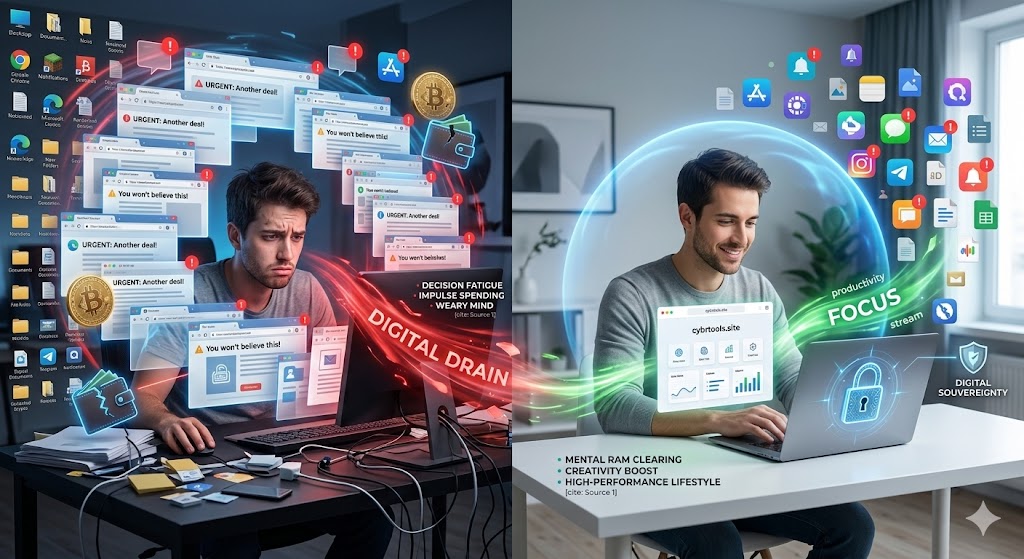
We’ve all been there. It’s 3:00 AM, the blue light of the laptop screen is stinging your eyes, and you have so many browser tabs open that the icons have shrunk into tiny, unidentifiable slivers. I found myself in this exact position recently: one tab had my project management suite, another had an AI image generator, a third had an SEO auditor, and the remaining 47 were “essential research” that I hadn’t looked at in three hours.
In that moment of exhaustion, a realization hit me: I had access to the world’s most sophisticated Web Tools, yet my actual output was zero. We are living in an era where the sheer abundance of digital tools is suffocating our innate ability to create. In 2026, the true master isn’t the one with the most tools, but the one who knows how to use the right ones with surgical precision. This isn’t just about productivity; it’s about reclaiming your mind from the digital noise.
2. Deciphering “Web Tool Fatigue”

The psychological weight of our digital environment is real. Every new tool we integrate into our workflow carries a “cognitive tax.” It’s not just the time it takes to learn the interface; it’s the mental energy required to remember where that tool sits in your process. This phenomenon is known as Web Tool Fatigue.
Symptoms of the Fatigue:
- Analysis Paralysis: Spending an hour researching the “perfect” tool instead of actually starting the work.
- Context Switching: The 40% loss in productivity that occurs every time you jump between different web interfaces.
- Notification Anxiety: The low-level stress caused by dozens of different tool alerts competing for your attention.
- Subscription Overload: Paying for “premium” features in multiple tools that offer 90% overlapping functionality.
3. The “Curation” Revolution of 2026
For the last decade, the mantra was “More is Better.” In 2026, the trend has shifted dramatically toward Digital Curation. The goal is no longer to have a massive software library, but to have a curated “Essential Hub.”
This is why platforms like cybr.cybrtools.site have become a staple in my professional life. Instead of downloading heavy software or managing dozens of specialized accounts, these all-in-one utility hubs provide exactly what you need without the bloat. When your screen is clear of unnecessary clutter, your brain has the space to perform “Deep Work.”
4. Building Your Minimalist Digital Workstation

To dominate the digital landscape in 2026, you must rethink your ecosystem. I’ve developed a 3-Tier System to keep my workflow lean and my output high:
Tier 1: The Core Processors
These are your non-negotiables. For a writer, it’s a distraction-free editor; for a developer, it’s a high-performance IDE. These should be the only tabs allowed to stay pinned.
Tier 2: The Utility Belt
These are the tools you need sporadically—converters, security scanners, or data formatters. Instead of installing permanent apps for these, use the Web Tools category as your temporary workshop. Use it, get the result, and close the tab. This keeps your system memory and your mental RAM free.
Tier 3: The Archive
Everything else goes here. If a tab has been sitting idle for more than 30 minutes, it belongs in a bookmark folder, not in your active browser window.
5. The Science of the “Blank Screen”
Psychologists have long noted that while a “blank canvas” can be intimidating, a screen cluttered with 100 tabs is paralyzing. This is due to Decision Fatigue. When your eyes are constantly scanning dozens of open windows, your brain is subtly evaluating which one to click next, even when you are trying to focus on just one.
| Activity | Cluttered Mind (The Tab Hoarder) | Minimalist Mind (The Tool Master) |
| Project Setup | 20-30 mins (Finding & syncing tools) | 2 mins (Direct action) |
| Focus Duration | Fragmented (Avg. 3 mins per task) | Sustained (Deep work sessions) |
| Stress Level | High (Feeling “Behind”) | Low (In Control) |
| Tool Efficiency | Using 10% of 20 tools | Using 90% of 3 essential tools |
6. Privacy & Security: The Hidden Cost of Free Tools

In 2026, your data is more valuable than your currency. A major risk of “Web Tool Fatigue” is the security holes we create by signing up for every “new and shiny” tool we see. Most people don’t realize that many free web utilities are actually data-harvesting machines.
When using tools on cybr.cybrtools.site, I prioritize privacy. By using browser-based utilities that process data locally rather than uploading it to a mysterious server, you protect your digital sovereignty. Security isn’t just about passwords; it’s about being intentional with where you enter your data.
7. The Professional Digital Detox: An Action Plan

I don’t expect you to stop using tools—I expect you to Master them. Here is my weekend protocol for a digital reset:
- The Tab Audit: Close every tab you haven’t interacted with in the last 60 minutes. If it’s important, bookmark it. If not, let it go.
- The Bookmark Purge: Delete 50% of your saved “Web Tools.” You likely use the same five 90% of the time anyway.
- The Single-Tool Challenge: Spend your first hour of work tomorrow using only ONE browser tab. If you need a utility, go to cybr.cybrtools.site, perform the task, and close it immediately.
8. Conclusion: Reclaiming the Human Element
At the end of the day, a tool is just an extension of your intent. A calculator can do the math, but it can’t tell you where to invest your heart. Web tools can boost your speed, but they cannot replace your vision.
Don’t let your creativity get buried under a mountain of browser tabs. Visit cybr.cybrtools.site, grab the essential tools you need, and then get back to the real work of creating, building, and leading. 2026 belongs to those who own their tools, not those who are owned by them.





Leave a Reply